







prohibitted persons
Restoring rights?
Interesting. But I wish the story explained how the person lost their firearm rights. I can only think of (1) it's some State disqualified or (2) while he was incapacitated following the stroke, they had a guardian created for his property, and that was treated as being found mentally defective.
Permalink · prohibitted persons · Comments (2)
2A "as applied" challenge victory
Binderup v. Holder, Eastern Dist. of PA, No. 13-cv-06750. (I won't attach it because it's an 86 page pdf).
By way of background: a constitutional challenge can be a facial one, aimed at the face of the statute (any and all applications of the statute are unconstitutional) or "as applied" (regardless of whether the statute itself is unconstitutional, its application to this person in this context would violate a constitutional command). This was an as applied challenge, brought by Alan Gura.
Plaintiff was convicted, long ago, under a State law punishing corruption of a minor (in this case, a 17 year old girl with whom he had an affair). The statute expressly terms this a misdemeanor, but allows a punishment of up to five years' imprisonment, making it a bar under Federal law (which bars firearms possession by anyone convicted of an offense punishable by more than one year, except for offenses expressly termed misdemeanors and punishable by no more than two years).
The court decides that, in light of the nonviolent nature of the offense, its antiquity, and the fact that plaintiff has kept a clean record before and since, using it to bar him from possession would violate the 2A.
Nice reasoning, and as we see more of these (and more payments of legal fees by the government) Congress might have an incentive to limit the disqualification to offenses that actually suggest a person is too risky to be allowed a firearm. That was raised back in 1968, and again when the GCA was rewritten in the 1980s, but encountered opposition that essentially went searching for statutes that would no longer be disqualifies but would suggest a person was a risk. (The final fall back was always "but they only got Al Capone for a tax violation.").
Permalink · prohibitted persons · Comments (2)
"Terrorist watch list"
There have been proposals by antigunners to ban firearms receipt by those on the "terrorist watch list," which make this article quite relevant. Based on a "leak," it points out that:
(1) Between 700,000 and 1.5 million people are on the list;
(2) The standard for listing is "reasonable suspicion";
(3) More than 40% on the list, some 280,000, are not even suspected of links to any known terrorist organization;
(4) 900 times a day, a person is added to the list or information on him is supplemented.
I must wonder how useful any "watch list" can be that has 700,000 people on it. Obviously that number cannot be "watched." The list just takes on a life of its own; it is maintained because it is supposed to be maintained.
Permalink · prohibitted persons · Comments (4)
Case on restoration of rights
US v. Indelicato, 97 F.3d 627 (1st Cr. 1996). The Gun Control Act technically doesn't forbid felons to possess guns; it forbids those convicted of a crime punishable by more than a year's imprisonment, or of one expressly denominated a misdemeanor, and not punishable by more than two years' imprisonment, to do so. It also provides that a conviction does not count if the person has received a restoration of civil rights. In most States, a crime punishable by more than a year's imprisonment is a felony, so the difference is zero.
At issue in Indelicato was defendant's status when he had been convicted of a Massachusetts misdemeanor that was punishable by up to 2.5 years' imprisonment. Since that's more than two years, it brought him with the Federal ban. But since it was a misdemeanor, which loses no civil rights, there was no way for him to have obtained a restoration of civil rights.
The court decided to treat the matter as if Indelicato had had his rights restored, in the sense that he never lost them in the first place. It acknowledges that several other rulings have gone the other way: since the defendant never lost his rights, he cannot get them "restored" and is forever barred. I think it's a good approach (why would Congress have meant a misdemeanant to have a lifetime bar, when a felon would not), although it's not in accord with the language of the statute. This is one of the cases where statutory "interpretation" actually involves, not figuring out the legislative intent, but figuring out what would have been the legislative intent if the legislature had foreseen an obscure situation, which it didn't know existed.
Permalink · prohibitted persons · Comments (4)
Interesting case from Ill. Supreme Court
Plaintiff sued for a Firearm Owner ID Card, required for gun possession. He had a misdemeanor DV. Apparently Illinois has no way to get rights restored after a misdemeanor. The State opposed, since its statute doesn't allow FOID cards to be issued to those barred from gun possession by Federal law, and there is the Federal bar against those with misdemeanor DV convictions.
As I read it the court holds that Federal law exempts from its prohibited person categories anyone convicted but who has had their rights restored, and that issuing the FOID is the equivalent of restoring rights (the statute does not say the rights must be restored by a court), ergo there is no Federal bar, and the FOID should issue.
Opinion here. Warning, it is a long pdf.
Permalink · prohibitted persons · Comments (3)
When is a felon not a felon?
Story here, and the ruling upon which it is based, here.
As I read it: here in AZ, the legislature completely rewrote the criminal code in the 1970s, classifying felonies into six classes, and then with sentencing provisions specifying the presumptive, minimum, and maximum sentences for each class, plus aggravating factors. North Carolina took an approach much like the Federal one: leave the offenses with the traditional "shall be sentenced to five to ten years" clauses, then impose a general sentencing provision, i.e., crimes carrying a sentence of 5-10 years will in fact be sentenced in this manner for first offense, and that for second offense.
In this case, the defendant had been convicted of small-time marijuana trafficking, first offense. The North Carolina statute on the offense said it was punishable by up to five years' imprisonment. But the general sentencing provisions said that would carry a sentence of more than a year only if the State pleads and proves aggravating conditions and a certain criminal history, which the State did not.
Simmons was later caught possessing a firearm. So was his past conviction for a crime punishable by more than a year's imprisonment, the Gun Control Act definition of a felon, or was it not? The Fourth Circuit initially ruled that it was -- the only test was whether the specific criminal statute said more than a year, in fact, if it allowed more than a year for the most aggravated form of violation. The Supreme Court remanded, and the Fourth Circuit reconsidered and held that it was not a conviction punishable by more than a year's imprisonment.
Permalink · prohibitted persons
Felons' right to possess in self-defense
Eugene Volokh notes that it is protected in Colorado case law. The discussion in comments is quite interesting.
Permalink · prohibitted persons · Comments (0)
Bad advice of loss of gun rights, plea bargains to DV
State v. Nickolas Agathis, 2012 NJ Super. Lexis II (Feb. 1, 2012). Defendant was arrested for DV, plead to it, without being informed that under New Jersey law he would be permanently barred from obtaining a firearm purchaser ID card, effectively barring him from firearm ownership. His counsel and the judge informed him that he could reapply for the card at the end of probation. The appellate court relied upon Nunez-Valdez, a recent US Supreme Court ruling voiding a plea bargain where the defendant was told that the plea would not affect his immigration status, when in fact it subjected him to immediate deportation.
The court had previously heard the case on direct appeal, and refused to grant relief. The intervening Supreme Court ruling (and, in a footnote, the decisions in Heller and McDonald) appear to have changed the situation. Note that both this and Nunez-Valdez hinge, not upon failure to inform the defendant of collateral consequences, but on the defendant being misinformed with regard to them.
Another noteworthy aspect: the appellate court treats this as ineffective assistance of counsel, but I think it's better analyzed in terms of whether the plea was "informed," regardless of the source of the misinformation. The fact that part of the advice came from the trial judge, rather than from counsel, should, I think, make the case stronger.
Hat tip to reader Alice Beard...
Permalink · prohibitted persons · Comments (0)
NY Times and the "terrorist watch list"
Yesterday's NY Times has an article on the "terrorist watch list, and here are a few segments:
The Federal Bureau of Investigation is permitted to include people on the government’s terrorist watch list even if they have been acquitted of terrorism-related offenses or the charges are dropped, according to newly released documents.
......
The 91 pages of newly disclosed files include a December 2010 guidance memorandum to F.B.I. field offices showing that even a not-guilty verdict may not always be enough to get someone off the list, if agents maintain they still have “reasonable suspicion” that the person might have ties to terrorism.
.......
Ginger McCall, a counsel at the Electronic Privacy Information Center, said: “In the United States, you are supposed to be assumed innocent. But on the watch list, you may be assumed guilty, even after the court dismisses your case.”
......
Normally, it says, if agents close the investigation without charges, they should remove the subject’s name — as they should also normally do in the case of an acquittal. But for exceptions, the F.B.I. maintains a special file for people whose names it is keeping in the database because it has decided they pose a national security risk even though they are not the subject of any active investigation.
......
The procedures offer no way for people who are on the watch list to be notified of that fact or given an opportunity to see and challenge the specific allegations against them.
Chris Calabrese, a counsel with the American Civil Liberties Union, called the watch list system a “Star Chamber” — “a secret determination, that you have no input into, that you are a terrorist. Once that determination is made, it can ripple through your entire life and you have no way to challenge it.”
Strange to recall that only last year the the Times had this to say:
There seems to be a strong sentiment in Congress that the only constitutional right suspected terrorists have is the right to bear arms.... The Senate Homeland Security Committee hearing on “Terrorists and Guns: The Nature of the Threat and Proposed Reforms,” concerned a modest bill sponsored by Senator Frank Lautenberg of New Jersey. It would allow the government to stop gun sales to people on the F.B.I. terror watch list the same way it does people who have felony convictions. Because Congress has repeatedly rejected this idea, 1,119 people on the watch list have been able to purchase weapons over the last six years. One of them bought 50 pounds of military grade explosives."
Not to mention this:
The mayor’s [Bloomberg's] speech is a plea for lawmakers to close the so-called “Terror Gap,” a hole in the law that prevents the federal government from blocking the sale of firearms or explosives to people on the the terrorist watch list. Because this kind of stuff is on people’s minds lately, we thought we would post the text of his prepared remarks.
Or this:
But the law is such that the F.B.I. can’t tell a gun dealer like Mr. Mastrianni not to sell a gun to somebody we think is a terrorist and whom the T.S.A. won’t let on a plane. Two years ago, 400 mayors, led by Michael R. Bloomberg of New York and Thomas M. Menino of Boston, called for this oddity to be eliminated.Permalink · prohibitted persons · Comments (1)
Interesting Colorado case on felons and self-defense
Posted by David Hardy · 17 September 2011 02:41 PMPeople v. Dewitt, discussed over at The Volokh Conspiracy. The Colorado court holds, based on the State right to keep and bear arms, that a felon charged with possession is entitled to a jury instruction on his right to self-defense if he presents any evidence on that issue (in this case the evidence offered was that there had been muggings and suspicious activity in the area, so it need not be "someone was coming at me with a knife" type immediacy.
Permalink · prohibitted persons · Comments (5)
Oregon: medicinal marihuana users can receive CCW permit
Posted by David Hardy · 20 May 2011 08:56 AMPdf opinion here. The problem is that medicinal marihuana use may be legal under State law, but it's still forbidden by Federal law, and GCA 68 bans firearm possession by illegal users of marihuana. The court holds that the Federal restriction does not override the Oregon statutory scheme. Note that this means that the Oregon permits are not now valid as an alternative to the Federal background check, as the court notes.
Permalink · prohibitted persons · Comments (5)
Interesting ruling
Posted by David Hardy · 25 November 2010 01:00 PMUS v. Huet, W.D. Pa. Defendant's live-in boyfriend plead out to felon in possession, and she was charged with aiding and abetting that possession. The court dismisses the indictment because there was no allegation or evidence that she aided or abetted other than by herself lawfully owning a firearm.
Then the court discusses Heller and McDonald, and concludes the indictment would violate the Second Amendment as well: "Were this Court to permit this Indictment to go forward, the Court would be countenancing the total elimination of the right of a sane, non-felonious citizen to possess a firearm, in her home, simply because her paramour is a felon, and not because of some affirmative act taken by the citizen. Under any level of scrutiny, said Indictment as to Huet is a substantial, if not unfettered, infringement on her Second Amendment right to keep arms."
Via the Volokh Conspiracy, which has interesting discussions in the comments.
Permalink · prohibitted persons · Comments (1)
Mental commitment, disarmament, and standard of proof
Posted by David Hardy · 9 October 2010 03:59 PMIt's a debate at the Volokh Conspiracy.
Permalink · prohibitted persons · Comments (0)
Suit over gun ownership by pardoned felons
Posted by David Hardy · 30 April 2010 01:21 PMStory here. I'd guess that the legislature forbade ownership by anyone convicted of a felony, and forgot to insert an exception for ones who are pardoned. If that's the case, there may be an interesting separation of powers question. If the State constitution gives the governor the power to pardon, can the legislature interfere with the normal effects of that?
Hat tip to Sixgun Sarah...
Permalink · prohibitted persons · Comments (1)
Order re: defendant transfers rights to his firearms before conviction
Posted by David Hardy · 14 April 2010 10:38 AMHere's an interesting recent district court ruling regarding firearm confiscation.
A gunowner named Edward Brown faced the fact that he might be convicted of felony tax fraud. If he was convicted, at that instant he becomes a prohibited person and the firearms are subject to forfeiture. As a condition of bail he turned his guns in to Federal authorities, to await the outcome. He then signed a document saying that if he became unable to possess firearms, his guns were to be turned over to a Bernhard Bastian. He was convicted, and Bastian asked for the guns.
A motion was filed, and a federal magistrate ruled that the guns might be turned over. Later, the government moved to forfeit the guns as substitute property (I assume meaning as part of the bail, which Brown had violated by fleeing).
The federal District Judge ruled that the magistrate's order was binding, since the government had not appealed it. It also finds that the order was valid. The government cited cases saying that a convicted felon cannot transfer his guns after conviction because that would be exercising "constructive possession" of them -- controlling them even tho they are not in his hands. The District Court rejects this idea, and also notes that Brown had transferred ownership before he was convicted. It notes that applying that idea to a transfer of ownership while the owner could legally transfer would raise Fifth Amendment issues (taking of property without compensation). It cites cases saying that, even after conviction, a defendant should be able to transfer ownership of non-contraband guns.
Permalink · prohibitted persons · Comments (2)
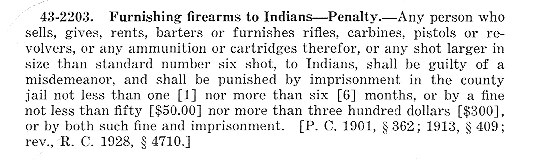
Prohibited gun purchaser, 1939 version
Posted by David Hardy · 6 April 2010 10:38 AMFrom Arizona's 1939 Code:
Under that code, the two classes of persons forbidden firearms purchase (but not possession) were (1) juveniles under age 14, who could not be sold handguns, and (2) Indians, who could not be sold rifles or handguns. (At that, there was no penalty provided for the purchaser, so a juvenile or an Indian would managed to obtain a forbidden firearm could keep it).
Permalink · prohibitted persons · Comments (6)
Case with implications for DV misdemeanor pleas
Posted by David Hardy · 31 March 2010 09:16 AMPadilla v. Kentucky, handed down this morning.
Defendant was a lawful permanent resident, and pleaded guilty to transporting a large load of marihuana. His attorney advised him not to worry about deportation, and he pled guilty. When he discovered that deportation was in fact inevitable, he challenged the plea on ineffective assistance of counsel bases, and a majority of the Court agrees. The opinion points out that various immigration reforms have changed the deportation consequence from something of a concern (the sentencing judge could recommend against it, and that was virtually binding) to an inevitability. The majority thus find that deportation is a key part of the penalty, and a person pleading out must be informed of it. (Alito and Roberts concur, on the basis that the attorney affirmatively misled the defendant; Scalia and Thomas dissent, arguing that counsel need not advise a defendant regarding collateral consequences of a plea).
Thoughts: (1) This would likely extend to misdemeanor DV pleas, where the defendant was not informed of the plea's effect on firearm possession, now that Heller establishes that as a constitutional right; (2) it may also have a bearing on pre-Lautenburg pleas. Defendants there could not be informed of the consequences, because there were none at the time of the plea, but this suggests that application to pre-enactment pleas is indeed an ex post facto increase in the penalty.
Permalink · prohibitted persons · Comments (5)
Medicinal marihuana and GCA 68
Posted by David Hardy · 23 March 2010 12:05 PMFrom an email making the rounds:
"Nevada has just started adding the names of those who have a lawfully obtained medical marijuana card to the "do not purchase" list. You are now denied if you try to purchase a firearm in Nevada (from an FFL). They don't come out to your house and take your already purchased guns (not yet anyway) but the do not allow any new purchases. "
The Gun Control Act bans firearm receipt (and possession) by anyone who "is an unlawful user of or addicted to any controlled substance (as defined in §102 of the Controlled Substances Act (21 U.S.C. §802)." The problem is that while the State has legalized it, the Feds have not; Pres. Obama has just given it a manner of dispensation, but the law remains in force.
I've heard it said that medicinal marihuana is a gateway drug; many users go on to full-blown chemotherapy.
Permalink · prohibitted persons · Comments (4)
7th Circuit questions ban on gun ownership by misdemeanor DV defendants
Posted by David Hardy · 18 November 2009 03:12 PMThere's quite a discussion at the Volokh Conspiracy, regarding today's decision that calls into question the Lautenberg Amendment. The court concludes that the law should be given intermediate scrutiny (in part because the firearm was possessed for hunting rather than self-defense), vacates the conviction and sends that case back for more fact-finding. The wording certainly indicates that the court is taking the challenge seriously and wants the parties to do so as well. Opinion here.
Hat tip to readers Todd, and to Alice Beard.
Permalink · prohibitted persons · Comments (4)
NC Supreme Ct holds old nonviolent felony no bar to gun rights
Posted by David Hardy · 29 August 2009 01:20 PMOpinion in pdf here, courtesy of reader Carl in Chicago. It's under discussion at the Volokh Conspiracy and by Instapundit. The latter makes a good point about "felony inflation." E.g., if the felony theft level is pegged to $500 (as I believe it was in Arizona's 1977 criminal code reform) ... in 1977 $500 was a lot of money. I was driving a used VW I bought for $600, and filling it with, as I remember, 40 cent a gallon gasoline, and living in a decent $175/month apartment.
Permalink · prohibitted persons · Comments (1)
US district court splits the constitutional baby
Posted by David Hardy · 19 June 2009 09:48 AMDiscussion here, over at the Volokh Conspiracy.
Permalink · prohibitted persons · Comments (7)
Supreme Ct interprets Lautenberg Amendment
Posted by David Hardy · 24 February 2009 09:54 AMIt's US v. Hayes. The question was whether to read the less than clear statute as requiring proof that the firearm possessor either (a) was convicted of a misdemeanor, whose elements were use of force, and against a household member, or (b) was convicted of a misdemeanor who element was use of force, with the government able to show in the firearm felony prosecution that it was in fact against a household member. (Defendant's underlying conviction was for generic battery, not specifically DV).
Majority, per Justice Ginsburg, goes for (b).
Roberts, joined by Scalia, dissents, going for (a). It's a straight statutory matter, Second Amendment neither briefed nor mentioned in either opinion.
UPDATE: courts got around the ex post facto problems by arguing (1) a violation of Lautenberg requires you to do something after its effective date, namely possess a gun and (2) as far as retroactively increasing the penalty for the DV charge, well, gun ownership is something like driver licensing or other such licensing, you can make licensing standards stricter without it being increased punishment for past acts.
I don't think (2) is viable in light of Heller. It's hard to see how stripping a person of a constitutional right, retroactively, for a misdemeanor, can't be seen as increasing the punishment for it.
Permalink · prohibitted persons
Heller and felons
Posted by David Hardy · 22 July 2008 08:33 AMDon Kates has an article in the NY Post on the topic.
Permalink · prohibitted persons · Comments (7)
NICS Improvements Act passes both houses
Posted by David Hardy · 19 December 2007 05:30 PMSen. Colburn's hold enabled him to get some improvements, too:
"Just before midnight Tuesday, Coburn and the Democratic supporters of the bill struck a deal: The government would pay for the cost of appeals by gun owners and prospective buyers who argue successfully in court that they were wrongly deemed unqualified for mental health reasons.
The compromise would require that incorrect records _ such as expunged mental health rulings that once disqualified a prospective gun buyer but no longer do _ be removed from system within 30 days.
The original bill would require any agency, such as the Veterans Administration or the Defense Department, to notify a person flagged as mentally ill and disqualified from buying or possessing a gun. The new version now also would require the notification when someone has been cleared of that restriction."
UPDATE: it's getting rather strange of late. Here's what Carolyn McCarthy said: "Together, we have crafted a bill that will prevent gun violence, but maintain the Second Amendment rights of law-abiding citizens" to bear arms."
Uh ... Second Amendment rights of individuals? Law abiding citizens? I didn't antigunners were allowed to use terms like that.
ANOTHER UPDATE: You can find extensive discussion from SayUncle and Snowflakes in Hell, as well as the National Shooting Sports Foundation. All say it's an improvement in the law, and I would agree.
Permalink · prohibitted persons · Comments (1)
Antigun group attacks NICS bill
Posted by David Hardy · 19 December 2007 05:06 PMthe Joyce Foundation bankrolled Violence Policy Center's press release of today. The high points:
"The "NICS Improvement Act" passed today by the Senate would:
-- Resuscitate a failed government program that spent millions of dollars annually to allow persons prohibited from buying guns to regain the ability to legally acquire firearms. The Department of Veterans Affairs (VA) would be required to establish a "relief from disability" program to allow persons now prohibited from possessing a firearm because they have "been adjudicated as a mental defective" or "committed to a mental institution" to apply to have their bar on firearms possession removed. As a result of the bill, more than 116,000 individuals would be eligible to apply.... Under the bill, states would also be required to establish such "relief" programs to restore the gun privileges of those with mental health disabilities in order to be eligible for potential grant money to upgrade records submitted to the NICS.
-- Set an arbitrary time limit for the VA to act on applications for "relief." If the agency fails to act within 365 days, applicants could file a lawsuit asking a court to restore their gun privileges, even if Congress fails to provide the VA with the appropriate resources to process these investigations. Some prevailing applicants would be entitled to attorneys' fees. ...
-- Significantly narrow the category of records of people with mental disabilities that would be submitted to the NICS by the federal government. The current permanent bar on persons with certain health disabilities would be replaced with temporary restrictions.
Kristen Rand, legislative director of the Violence Policy Center, states, "This bill was intended to be Congress' response to the mass shooting at Virginia Tech that left 32 people murdered. But rather than focusing on improving the current laws prohibiting people with certain mental health disabilities from buying guns, the bill is now nothing more than a gun lobby wish list. It will waste millions of taxpayer dollars restoring the gun privileges of persons previously determined to present a danger to themselves or others. Once a solution, the bill is now part of the problem."
Josh Horwitz, executive director of the Coalition to Stop Gun Violence, adds, "It is ironic that the gun lobby has coerced the Senate into providing resources to rearm mentally disabled veterans during a time when the VA is struggling to provide adequate mental health care to those in need."
Permalink · prohibitted persons · Comments (2)
List of people barred by mental treatment doubles in size
Posted by David Hardy · 30 November 2007 02:15 PMFBI reports the list has more than doubled in size, from 175,000 to 400,000.
This sorta thing is why I didn't take umbrage at the bill proposed a while back to change things. It didn't add anyone to the prohibited persons list. It would have expanded the number of names on the list, but anyone who had been committed but was able to get a firearm because they weren't on the list would be liable for a felony charge anyway. It did give people on the list a way to get off, for the first time. A person convicted of a felony can in most states get his firearm rights restored after passage of time -- but there is no such procedure for a person who has had a mental committment. They're barred for life, period. I judged changing that would be worth having more names on the list, when everybody being added was already barred and would be set up for a felony charge anyway.
UPDATE: originally, the Fed rule was once a felon, always one, no matter what State law provided. Then the 1986 amendments to GCA changed that, and allowed State restorations of rights to restore Federal rights as well. (Exact execution depends on State law -- in AZ it was originally automatic, then gun rights took a separate motion (while other civil rights were restored automatically), then the legislature put in a detailed system where the person must wait so many years if it was some classes of offense, a longer time if it was in certain classes, and never if it was a really serious offense).
There's some area of dispute (for example, some States have "expungement" of records that doesn't really expunge them -- they're still on record and can be used to prove a second offense -- does that count as expungement of the conviction?)
Permalink · prohibitted persons · Comments (6)
Definition of "committed"
Posted by David Hardy · 29 September 2007 04:14 PMClayton Cramer has an interesting posting relating to an article in Journ. of the American Academy of Psychiatry Law. The gist of it is that the cases are clear that an involuntary committment can create prohibited status under GCA 68, they're all over the place beyond that point. Some say that a temporary emergency committment that doesn't lead to a formal committment proceeding is no bar to gun ownership. Others say that a procedure where the committment order is issued by two physicians, without judicial findings, is enough.
Going to the article he cites, indeed it is a mess, beyond the principle that if a committment is for observation, without subsequent finding that the person is indeed insane, he's probably in the clear.
At the level of state law, it's even worse. In four states, voluntary committment, or diagnosis without committment, can be a bar. In California, just being given a 72 hour committment for observation is a bar, altho it ends after five years. Four states have no bar based on psychiatric findings at all.
Permalink · prohibitted persons · Comments (5)
Wyoming appeals ruling vs. BATF
Posted by David Hardy · 18 August 2007 09:11 AMStory here.
Essentially, Wyoming treats DV convictions as do many states. A person can later apply to have the conviction "expunged." If the court grants it ... well, lotsa times in the law the law does one thing and the reality is another. The court issues a ruling saying the conviction is set aside and expunged. But the conviction in the files isn't torn up, nor sealed. And if the person is charged a second time, it can be cited to prove this is a second offense. This arrangement, BTW, is quite common.
GCA 68, as modified by the 86 amendments in FOPA, says a conviction doesn't count if it has been expunged or set aside. ATF's position is that the statute and its history doesn't define "expunged," and if a conviction is still on file and has legal effect, then it ain't expunged. Wyoming position is that the purpose of FOPA is to make state law govern a state conviction (as it did not prior to 1986) and the statute, and the court orders, say "expunged."
For my money (and I actually had a role in drafting that part of FOPA, not a big role, Jim Featherstone did most of it but he's dead and can't be asked) -- the parties ought to research the history of expungement as it existed while the statute was being debated (1979 or 1980 to 1986). As I recollect, the first big expungement proceeding at that period was the Federal Youth Corrections Act (sort of like federal juvenile court, but extending up to age 25, I think). Some national body had recommended that states adopt similar provisions, and they were starting to do so at this time. So, to my mind, if the state statutes of that period paralleled those of Wyoming, then that's the background in which Congress acted, in which expungement either did or did not mean completely wiping out the record and nullifying all legal effects. I haven't done the research and don't know what the answer would be.
Permalink · prohibitted persons · Comments (0)
4th Cir ruling on felons' possession in self-defense
Posted by David Hardy · 6 August 2007 11:00 PMIt's under discussion over at the Volokh Conspiracy.
Permalink · prohibitted persons · Comments (3)
HR 2640, mental committments and all that...
Posted by David Hardy · 13 July 2007 09:38 AMClayton Cramer has a take on the bill and, while I haven't puzzled thru all its details, I agree with all the points he makes. It puts more mental health records in the system, but doesn't bar anyone who is not already barred. On the other side, it gives those who are barred (and at the moment a committment is a lifetime bar) an avenue (I think two avenues, but my memory may be off) to get the bar lifted. That alone will benefit two (former) shooters that I know.
Yep, I think it's a big improvement in this area. What formerly was available -- "relief from disability" (to own a gun) granted by BATF (which was actually pretty decent about granting it) has been blocked for over a decade by budget riders forbidding BATF to spend any funds for that purpose. The bill, as I recall, mandates that States create systems so that persons with a committment can get relief that way, and also creates a federal system for VA committments, etc.. It's not called relief from disability, so the budget riders shouldn't affect it.
Permalink · prohibitted persons · Comments (9)
Felon in possession and business offenses
Posted by David Hardy · 2 July 2007 11:38 AMDecision of the Day reports an 8th Circuit ruling on felon in possession. The defendant had been convicted in 1984 of selling meat in violation of the Federal Meat Inspection Act. In 1994 he brought a declaratory judgment action to determine that this was not a disability to own guns, but the 9th Circuit ordered dismissal for lack of standing. In 2005, he was charged and convicted of felon in possession.
His defense (and I assume the basis of the dec. action) was that the GCA says certain business offenses are not within its definition of felony conviction:
"The term “crime punishable by imprisonment for a term exceeding one
year” does not include—(A) any Federal or State offenses pertaining to
antitrust violations, unfair trade practices, restraints of trade, or other
similar offenses relating to the regulation of business practices."His focus was of course on the "or other similar offenses" language. The Eighth Circuit opinion (pdf) goes against him, and affirms his conviction.
Interestingly, Judge Bright's dissent argues that the statute (at least in this context) is void for vagueness. "The similar offenses clause of § 921(a)(20)(A) could be read as the majority determines, or otherwise, as contended by Stanko. Either is a plausible interpretation of the text. Stanko should not be convicted under a statute that is so uncertain as to its meaning, and therefore I respectfully dissent." He also points out that the earlier 9th Circuit ruling underscores his concerns: "our system of laws should not accept a statute so vague that an individual must suffer the harm of a § 922(g) conviction before learning from the courts whether his prior conviction falls within the scope of § 921(a)(20)’s exemptions."
BTW--I remember how this exemption got into the law. It dates from before GCA 68, back when they had the looser Federal Firearms Act. A major company that had an ammo business -- might have been Olin -- got convicted of felony antitrust violations, as I remember. So Senator Dodd, who was always on the lookout for fast influence and cash, got this amendment passed so the corporation wouldn't have to sell off its ammo business.
[UPDATE: Yup, it was Sen. Tom Dodd, father of the present Senator. He set something of an early record for corruption, and got censured by the Senate (for what he got caught at -- there was a lot that he got away with. In those days, you could take a "campaign contribution" and essentially stick it in your pocket if it wasn't used for campaigning, none of the modern idea of campaign contributions are separate from your personal bank account. So he'd announce some big investigation of, oh, insurance companies, gun companies, drug use in professional sports. And after the recipients of legislative attention sent the right contributions, would abandon the inquiry.
So why GCA '68? The answer is that the major domestic gun manufacturers WANTED the legislation. They were getting killed by interstate mail order houses selling cheap military surplus. They wanted something to (1) outlaw imports of surplus -- which GCA 68 did, in a provision later relaxed -- and (2) require people to buy from dealers in their own state, thus ending the mail order houses.]Permalink · prohibitted persons · Comments (3)
Proposal to add terrorist watch list to prohibited person category
Posted by David Hardy · 10 June 2007 10:23 PMAn interesting discussion at the Volokh Conspiracy about Walter Murphy, retired Colonel of Marines, and Professor Emitus at Princeton, who finds himself apparently on the "watch list."
Permalink · prohibitted persons · Comments (2)
6th Cir. en banc on felon in possession
Posted by David Hardy · 19 May 2007 11:51 AMAt the Volokh Conspiracy, Prof. Adler discusses three en banc decisions, one relating to felon in possession. (A pdf is available via his posting).
I think the split between the judges keys on a slipup in the indictment. Defendant's girlfriend called 911, saying that he had a gun and was going to kill her. Police arrived five minutes after being dispatched, but luckily the guy had left and left her alive. She describes him as holding a blued semiauto, and racking the slide. He returns in a car, his mother driving. A gun meeting the description is found under his passenger seat, in a plastic bag, with no fingerprints. The key is that the indictment charged him with possession of that specific gun. If it hadn't been so specific, the girlfriend's testimony that he held a gun on her would have been sufficient -- but now the prosecution was bound to prove it was that specific gun found under his seat.
The majority finds that sufficient to uphold the jury's verdict. It could reasonably have concluded that after he left the scene, he wiped the gun of prints, put it in the bag, and returned. The dissent says that's not enough, citing caselaw to the effect that finding of a gun under a car seat is insufficient to make the driver or passenger in "possession," without further proof he knew it was there.
Permalink · prohibitted persons · Comments (0)
Proposal to bar gun sales to those on terrorism watch list
Posted by David Hardy · 27 April 2007 09:02 PMSen. Lautenberg and the Justice Dept are both backing a bill to forbid gun sales to people on the terrorism watch list.
The good news: somebody finally found a way to disarm Ted Kennedy.
I suppose it would be better to take his driver's license....
Permalink · prohibitted persons · Comments (7)
Clayton Cramer on mental disabilities
Posted by David Hardy · 19 April 2007 10:36 AMClayton Cramer has a post on the issue.
The ultimate question comes under "damned if you do and damned if you don't." Before 1970s or so (i.e., just before I went to law school) the committment laws allowed committment of just about anyone with any significant mental quirk. Arizona Law Review had an issue on that, and they tracked down the person who'd had the longest time in the state mental hospital ... a woman committed something like 50 years before because the doc said "she always felt like dancing."
The legal reforms that went in after that basically deinstitutionalized all but a handful of the mentally ill. As a general rule, unless a person could be proven an immediate danger to self or others (which is hard to determine unless maybe they were paranoid schitz and specifically said they were going to kill someone else) or so completely disabled as to be unable to function, they could not be held. A large part of those released, or not held, wound up on the streets, of course. Of course in the old days there was no real treatment for serious disorders. At best, you warehoused them, usually for their lives. Today you have enormous advances in psychiatric medications, but if the person won't take them, you're out of luck. And some take quite a while to kick in, weeks sometimes, so you can't just make the guy pop a pill and reach a state where he realizes he really is better off on the medication.
The bottom line was that there was no good solution -- at best, you can look for the "least bad" one.
Permalink · prohibitted persons · Comments (0)
Challenge to felon in possession turned back
Posted by David Hardy · 28 December 2006 08:37 PMThere's a discussion of a 6th Circuit case, rejecting a challenge to prohibited person prosections as "selective prosecution" based on race, over at the Volokh Conspiracy
The debate reflects a problem that often occurs: (1) if you allow a challenge to be made, and discovery to be obtained, based on little evidence, you'll spend a lot of time sorting out those challenges and (2) if you require the defendant to come up with the evidence without discovery, odds are no challenge will ever be made. Courts in that situation tend to go with (2). Maybe I'm cynical, but the fact that (2) entails less work for the judiciary may play a role.
Permalink · prohibitted persons · Comments (1)
Thoughts on DV cases
Posted by David Hardy · 31 October 2006 01:46 PMFederal law prohibits firearms possession by persons convicted of misdemeanor domestic violence. It defines DV as an offense that has, among others, "has, as an the element, the use or attempted use of physical force," against a cohabitant (or, curiously enough, a former spouse, regardless of whether they are cohabiting).
Current immigration law allows removal of an alien who commits an act of "domestic violence," defined as "any crime of violence" as defined in 18 USC sec. 16) against an intimate partner. 18 USC §16 in turn defines crime of violence to include “(a) an offense that has as an element the use, attempted use, or threatened use of physical force against the person or property of another." Pretty close to the GCA definition.
The Ninth Circuit recently ruled in Fernandez-Ruiz v. Gonzales (No. 03-74533 (Oct. 26, 2006) that Arizona's DV statute did not qualify as grounds for deporation under the federal standard. The reasoning seems to be that under the Arizona statute, a conviction can be had for reckless, nonintentional, use of force, and that a reckless use of force (even tho literally within the coverage of the statute's term "use of force") is not covered by the statute.
The Circuit notes that its earlier cases had suggested that recklessness was enough, but now it relies on the Supreme Court ruling in Leocal v. Ashcroft, 543 U.S. 1 (2004). Since the relevant element of the Arizona statute is not limited to intentional use of force, an Arizona DV conviction is not a crime of DV under the federal immigration law.
Of course, when in the Ninth Circus, we have to bear in mind that the same statutory language may have radically different meanings when a gun owner and gun law is involved.
Permalink · prohibitted persons · Comments (0)
9th Cir.: no exception to felon in possession
Posted by David Hardy · 5 September 2006 07:44 PMThe 9th Circuit has affirmed a refusal to give a jury instruction that a felon is not guilty of possession if the possession was brief and for a lawful reason. The DC Circuit has allowed such instructions; the 1st, 4th, 7th and now 9th have not.
The defendant's story, which had some BIG holes (but has to be treated as if true for this purpose) was that he found a gun near a school, took it home, unloaded it, and went off to the police station to report it.
Permalink · prohibitted persons
Interesting case on DV orders. Commerce & 2d Amendment
Posted by David Hardy · 6 July 2006 04:05 PMJust came across United States v. Napier, 233 F.3d 394 (6th Cir. 2000), which deals with a wide range of gun issues (and with most of them incorrectly, but what did I expect?). I've got the text in extended remarks below.
Essentially, it's a prosecution for firearms possession after a DV restraining order was issued (the guns having been purchased long before the order). He was also indicated for possessing ammo after such orders issued. Major rulings:
1. He challenges on due process grounds: court holds ignorance of the law is no excuse unless the law is exceptionally ambiguous or obscure. An earlier case had upheld a conviction because the notice of restraining order said that def. was not to possess arms -- here, he points out, he never was served with the orders. Court says that's not a distinction. Fact that a person knows there has been a DV order is enough to put him on notice that it might affect his gun rights.
2. Commerce Clause challenge: Court notes that the power extends to three categories, last being things having substantial relation to commerce. Court distinguishes Lopez: gun free school zone law had no commerce nexus, no statement that possession is only forbidden if you do X or Y in relation to commerce. GCA 68 prohibitions do contain commerce limitations. They apply only (and here court is a bit off) to guns that have moved in commerce. (Court does not explain why having moved in commerce at some point in history fits under subtantial relationship to commerce).
He also points out he got the firearm before he was subject to the order. I've mentioned before, on the face of the statute, this is not an offense. The "receipt" bar relates to a gun that has ever moved in commerce -- but he wasn't subject to the order when he rec'd it. The bar on "possession" ONLY relates to possession "in or affecting" commerce. So... the court ignores it. OK, the statute is valid because it has a commerce limitation, but the court isn't about to apply that limitation.
Court also disposes of a number of other Supreme's rulings suggesting that commerce clause limitations, well, actually exist. (This comes under the "we can't believe the Supreme Court meant that") approach.3. Second Amendment is blown off with a reference to the Warin case. "Recent scholarship, however, does not provide a sufficient basis for overruling an earlier decision of this Court."
Continue reading "Interesting case on DV orders. Commerce & 2d Amendment"
Permalink · prohibitted persons · Comments (4)
Federal judge gives world-class butt chewing
Posted by David Hardy · 1 June 2006 02:27 PMThe US Attorney for Montana just got a world-class butt-chewing over a felon in possession case.
The defendant had been convicted of what sounds like manslaughter ten years before. After his release, he developed a mult-million dollar construction business, became a bit of the pillar of the community, etc. In 2004, it was discovered that he owned guns, and (while the article is unclear) the state apparently moved to revoke/modify parole based on it.
Then the US Attorney (apparently having lots of spare time) filed federal charges as well. The judge's point was that the State had taken care of the matter, the defendant obviously is no street thug or menace to the community -- why is this a federal case? It didn't help that the prosecution had previously evaded the Speedy Trial Act by dismissing the indictment and then re-filing it to start the clock running all over again.
[UPDATE: link fixed...thanks...]
Permalink · prohibitted persons · Comments (2)
Lautenberg and ex post facto
Posted by David Hardy · 12 May 2006 02:40 PMOver at Gun Law News there's a debate on whether the Lautenberg amendment (making persons convicted of misdemeanor domestic violence into persons prohibited to possess guns) violates the ban on ex post facto laws.
I think GLN has it right. Lautenberg doesn't violate one arm of ex post facto (you can't criminalize conduct retroactively -- Lautenberg passes muster because to violate it a person must possess a gun after it was enacted) but does violate the other arm, at least for DV offenses commited before Lautenberg was passed (you can't increase punishment, in this case for the DV offense, after the offense was committed).
Not that any court's going to buy the theory. As I recall, they either ignore it, brush it off, or reason by analogy that putting conditions on something like permit or licensing isn't punishment. It might be interesting to bring a case in the Fifth Circuit, tho, since that circuit has recognized that the Second Amendment is an individual right. It's hard to apply reasoning keyed to permitting (government has no duty to license a person, it merely grants a privilege) to a restriction, indeed a complete cutoff, of a constitutional right.
Permalink · prohibitted persons · Comments (1)
Wyoming sues ATFE
Posted by David Hardy · 11 May 2006 11:47 AMVia Alphecca comes this AP story of a lawsuit filed by Wyoming.
The Lautenberg amendment bans gun possession by persons convicted of misdemeanor domestic violence. The 1986 amendments to the Gun Control Act (some of which I drafted, long story) provide that a conviction is not a conviction if it has been expunged or set aside or rights have been restored (unless the order doing so, or the State law, provides that it does not restore firearm rights).
The local ATFE (this is the only case I've heard of it happening, so I think it's a local position) took the position that a conviction is not "expunged" unless its effects are entirely wiped out. Wyoming, like most states with expungement proceedings, doesn't really wipe them out -- the order says that they are, but in fact they can be used to enhance sentences in case of a second offense.
I think the local ATFE is in error here. Most expungement statutes work in the way the Wyoming one does. And the statute also recognizes restorations of civil rights (voting, etc., in the case of felonies) that do not affect the conviction at all. It's hard to see why Congress would have wanted a provision to apply in the case of a felony but not in the case of a misdemeanor. I suspect the US Attorney will roll over on it, but if not, the case might pose some interesting Second Amendment issues as well. After all, even the collective rights approach agrees that a State could raise the issue....
Permalink · prohibitted persons · Comments (0)
Webpage on felon in possession state statutes
Posted by David Hardy · 4 February 2006 04:45 PMNetscape has an interactive map that shows how different states treat felon in possession situations. It seems quite accurate for my state (Arizona). It indicates that Vermont, interestingly, appears to have no State no felon in possession restriction.
Permalink · prohibitted persons · Comments (2)
Another dumb crook story
Posted by David Hardy · 1 February 2006 03:46 PMA gunsmith notices that the guy who brought in guns for repair is wearing one of those house arrest ankle monitors...
[UPDATE in light of comment -- I'd agree that whoever was supposed to be monitoring the guy's ankle monitor oughta be in hot water! Technology is only as good as the humans operating it.]
Permalink · prohibitted persons · Comments (1)
Cf. domestic violence restraining orders
Posted by David Hardy · 21 December 2005 03:11 PMThe Volokh Conspiracy has a great post regarding a (non domestic) restraining order issued in New Mexico. Petitioner alleges that David Letterman is has been causing her distress over the last ten years by inserting "code words" about her into his program, causing bankruptcy, sleeplessness and mental distress. She requests that Letterman be forbidden to think of her. The judge signed the order, albeit without a "think of" provision, and set hearing for January 12.
Upon being questioned by the media, the judge assured them that he had read the application before issuing the order. Personally, if I was him, I'd rather have people think me incompetent than insane.
Good comments, too, on how easy it is to get a domestic violence order, and a case where a secretary simply opened the order to the signature page and the judge signed it, without reading what he'd signed, let along the petition. As commentors note, the judges are scared that if they refuse an order, and anything happens, their name will be in the papers, whereas if they issue every single one, there is no risk.Permalink · prohibitted persons · Comments (0)
4th Circuit on "innocent possession" defense
Posted by David Hardy · 3 December 2005 12:28 PMVia the interesting and new Appellate Decisions blog:
The Fourth Circuit has just handed down US v. Gilbert (04-5004, Nov. 28, 2005), refusing to recognize an "innocent possession" defense to felon-in-possession charges where possession was " transitory and without illicit motive." Gilbert, a felon, claimed that he found the gun while on the way to work and meant to turn it in to the police. (As the court notes at the end of the opinion, his explanation is a bit fishy).
The Court notes that felon-in-possession requires only a "knowing" state of mind, not a "willful" one like much of the rest of the Gun Control Act (after its 1986 amendments). It refers to a prior decision that suggested there might be a justification defense where the felon was under imminent threat of death or injury and possessed a gun only to defend himself.
Sounds like a split in the circuits -- it notes that DC circuit has recognized innocent possession, while the 7th and 10th, and now the 4th, have refused.
Permalink · prohibitted persons · Comments (0)
5th Cir. rules on illegal alien as prohibited person
Posted by David Hardy · 18 June 2005 03:17 PMThe Fifth Circuit has issued an interesting opinion relating to the status of an illegal alien vis-a-vis the Gun Control Act. United States v. Orellana, 405 F.3d 360 (5th Cir. 2005).
18 U.S.C. § 922(g)(5)(A) makes it unlawful to possess a firearm while being an alien "illegally or unlawfully in the United States." The defendant was a Salvadoran who entered the US illegally. After his entry, El Salvador experienced earthquakes, and the Attorney General used his legal powers to allow Salvadorans to apply for "Temporary Protected Status," where they could remain in the US and seek employment, at least until the TPS was lifted. The defendant applied for and got that status, then found work as a security guard. During an investigation of use of illegals by private security firms, federal agents came across him while he was armed and on duty. He was convicted of illegally possessing the gun and sentenced to 18 months' imprisonment.
The Fifth Circuit found it quite difficult to determine Congressional intent in this situation (the law allowing TPS was enacted long after the Gun Control Act was, and neither statute had any useful legislative history. BATF had promulgated a regulation indicating that an illegal alien who later received TPS was still forbidden to own arms, but the court declined to give much deference to the regulation, noting that the degree of deference given an agency in the setting of a criminal prosecution is uncertain and the agency here had no particular expertise in immigraton law. Finally, it noted that the government itself in another appeal had conceded that ATF regulations were not entitled to deference.
In the end, the court held the situation sufficiently ambiguous to justify the application of the rule of lenity: if a statute can be construed with about equal validity in two different ways, the court should choose the more lenient construction; if Congress wanted the stricter one, it should say so without ambiguity. "After conscientiously applying our circuit's rules of statutory construction, we cannot say with certainty that Congress intended to criminalize the possession of firearms by aliens who have been granted temporary protected status. It may be sound policy, but as such its wisdom has no call upon the judicial power. When Congress does unambiguously render conduct illegal through appropriate legislation, it is not our task to offer supplementary and clarifying amendments."